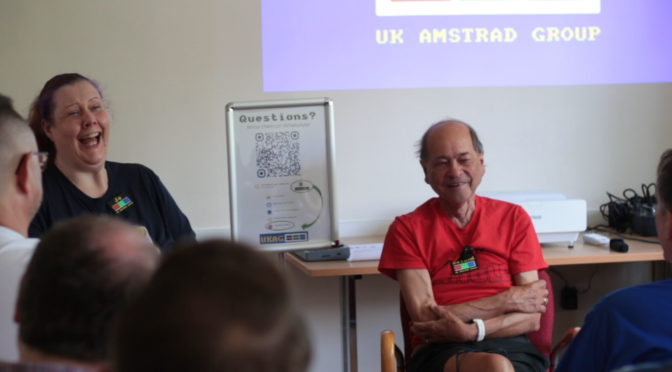
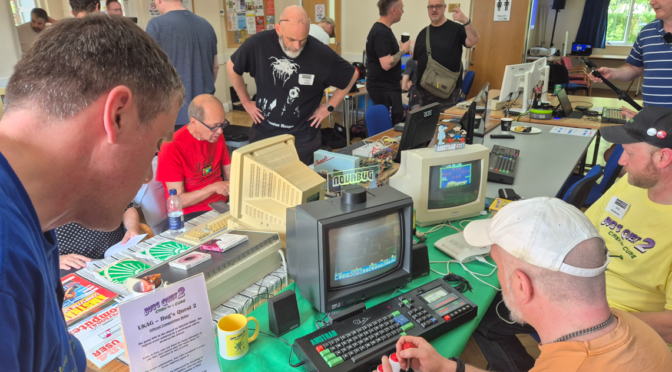
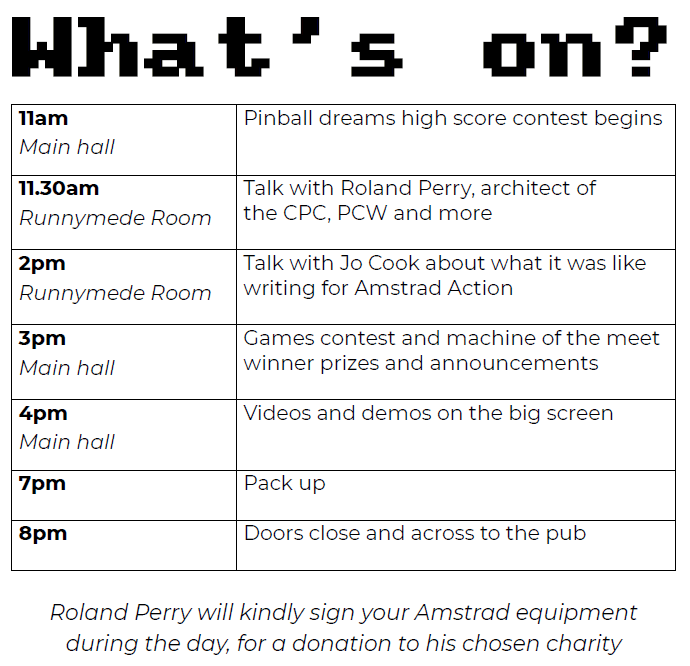
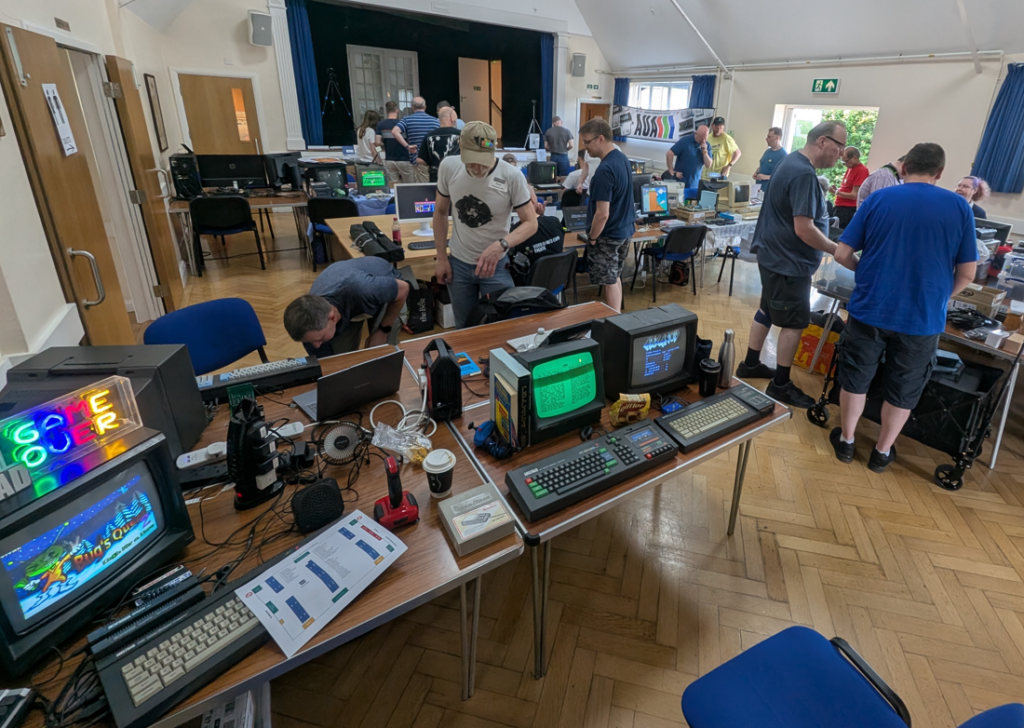
At the first UK Amstrad Group meet, Jo Cook shared the story of how Amstrad became such an important part of her life.
Starting with her first CPC 464, Jo talked about favourite games, helping her dad run Merline-Serve, writing for WACCI and eventually contributing to Amstrad Action while still a teenager.
The presentation also includes memories of Future Publishing, the Amstrad Action team, reviewing software and hardware, and how those early experiences helped shape Jo’s later career in journalism, training and learning and development.
It is a funny, personal and sometimes emotional look back at Amstrad, family, writing and community.
Watch the full presentation on YouTube!

Transcript from TechSmith Audiate:
My name is Jo Cook. And how many of you have read Amstrad Action? A few. You won’t remember my articles because I quite frankly don’t remember my articles. But I was published under Angela Cook. I just thought I’d give a little bit of an insight into what it was like working at AA.
And usually the first question is, how did you get to work for AA? So to start there, you know, I have to go back in time just a little bit. And here we are. So unfortunately, we didn’t have that many pictures back in the 1980s like we do now. Eight million pictures a day.
I have used ChatGPT, love it or loathe it, to create some images from some reference stuff. The very first Amstrad that I ever had was a 464. It was bought by my mum and dad, and my stepdad paid the extra to get the colour monitor. So we have the very posh setup.
Now this is put together by AI. Can anybody spot any issues other than my haircut… Yeah, the panel on the 464 the connectors and that is all shades of wrong.
So it’s not perfect, but it gives you a flavour. Yes, reminiscent of. So, we played obviously as kids all sorts of games. Arkanoid was a favourite. Who likes Arkanoid?
Hey, who loves Chuckie Egg? Hey, I can still hear the music. Dun dun dun dun dun dun dun dun dun dun dun died again. Also, my brother and I loved playing Gauntlet. Did anyone play gauntlet back in the day?
Yeah. We often got to, like, level 99, and then it would crash. It’s like, no. My brother listened to one of my Retro Hour podcast, I think it was.
This and I can’t believe you didn’t mention Boulder Dash. You didn’t mention tubing and, or the other swimming one, which I can’t remember the name of. So I’ve put that in there for him, but obviously lots and lots of other games. But some of those were some favourites. One of the reasons we got so deeply into the Amstrad CPC was my late dad.
Um, and he kind of really got into this. He was into the electronics part of it. And, really, we needed a way to fund the hobby because, you know, computers were expensive back then. And this is my dad with his CPC 6128 and a DMP, I think, two thousand printer, I can’t remember now, Up in the corner there. Although this is taken a little bit later in the 1990s and what you’ve got kind of on the left of him, some gray disc boxes.
That was King Arthur’s domain PD library. We we sort of inherited it from someone, although I’ve got no idea who that’s lost in the annals of time. And my dad liked to tinker with things and mod things. And so we have what we call affectionately the Franken CPC, because there’s all sorts of things he did and rumble boards and extras and plugged in. We still have a lot of it today. Simon still got the chassis.
He’s he’s removed a lot of the components, but we’ve still got, um, a lot of what’s going on in there. Now, admittedly, this picture was a little bit later into the early 2000s where you can see a couple of PCs. But my dad’s 6128 still sitting there. And what’s on the cover on the left is a PCW that was probably a 9512. So we definitely were still into this way into the two thousands. This is another ChatGPT image.
We ran something called Merline-Serve and yes, it should really be pronounced Merline. And it was called Merline-Serve because my dad had King Arthur’s domain. So I was therefore Merlin and we ran Merline-Serve. That’s the entire branding behind that. But basically, it was just a way to fund the hobby.
We would buy and sell kit. My dad would do some repairs. Not everything was a Franken-CPC. And this is a ChatGPT image from some reference photos and some prompts.
And scarily, it is not too far from from the truth. Rob, do you remember back in the day? It’s it’s pretty close, isn’t it? Which is… A bit scary.
Yeah. And it’s…I’ll be honest. There was a time it became a little bit of a problem, the hobby that we had, but we’re gonna gloss very quickly past that and focus on all the good stuff. This is a quite a bad ChatGPT rendering if you ask me, but it gives you an idea. I did say make my dad, soldering a PCW, PCB board, and that’s what it came up with.
So I’ve no idea what PCW it thinks that is. But it does give you an idea. I was kind of running more of the business side. Now I was a young teenager at this point, and I was handling the phone calls because, uh, it turns out, my dad, as I realized now, was an undiagnosed autistic. He probably had depression and stuff like that.
So he didn’t like talking to people. He definitely liked tinkering and doing that stuff. So I’m the one that handled kind of all the inventory and that kind of stuff. So I learned a lot from those years.
Does anybody remember WACCI, the fanzine WACCI? Oh, a couple of nods. Not many hands. So this was a fanzine rather than a magazine.
It was quite a technical magazine, um, but it was one of the bigger, if not the biggest one in the UK. And my, dad ran the tape library for it for a while. I got involved with it as well. I wrote some stuff, and I wasn’t that techie.
So I have got a technical background, but not techie anything like some of the guys are here today. So I focused very much on things like reviews and interviews. So I, reviewed fluff. Now this came much later in the Amstrad days.
Does anybody remember fluff? Yeah. It was a bit like a candy floss pink Sonic the Hedgehog. It’s kind of how I liked it at the time.
And it was written by a guy called Rob Buckley, and, so I interviewed him. I became really good friends with him, but I’d never met the guy in real life. How I got writing for AA, it was through Rob Buckley, because Rob had, was going to be writing the basically basic comment column to teach people how to do basic programming. But he was notoriously bad at deadlines.
So enter someone stage left who said, well, I can help with that. I’ll keep you to deadline. I’ll do kind of the article bit. You do the bit that I have no clue about, the programming.
So between us, that’s what we did. So he’d send me the type in. I’d write the article and put it on a three and a half inch floppy disk, post it off. So those were the deadlines where you had to kind of make sure you were sending it two weeks ahead of time, which I never did.
It was always late even though I’m supposed to keep Rob Buckley on time. Um, and, can you spot all the spelling mistake of basically up there? Basickly, Basick. This is Angela Cook with an e. The next month, they got it right.
So so that was rather nice, indeed. So that’s what started me writing for, Amsterdam. I was still a teenager. I was maybe fifteen when this happened.
I started all of this very young. It was a real joy to see in a column, in, like, the first or second page, and then it had things like, the contributors. And there’s my name in there, and I kinda got a bit of a thrill from it. And I still get that thrill today, whether it’s a podcast or an interview or a YouTube video, all of that kind of still thing or report that I’ve written for work.
I still kind of get that little thrill, which is absolutely lovely.
Another ChatGPT image for you. So this is, um, rendered as if were in, Future Publishing who started Amstrad Action. How many of you know that Amstrad Action was the first magazine for future publishing? A few if you do.
And that’s kind of why AA, stayed running for so long. So it got down to literally, like, half a page, by the end of it, and he put it in front of a fan and it would blow away. But that’s because Chris, Anderson, whatever his name is, who started AA and started Future Publishing, had that bit of passion and that bit of love, which is very nice. We’ve probably got a couple of more years out of AA because of that.
So when I was sixteen, I went and did some work experience at Future Publishing. And the office looks a little bit like this, quite frankly. Lots of PCs. It was the first time I got to use the Internet. And, it wasn’t the web like it is now.
But, you know, how many of you were using the Internet way back in the early 1990s? A lot of you are a lot older than me. Excellent. And, um, it was very different to now.
I was connecting to servers and seeing lists of things, and I didn’t really quite get what it was about. I knew it was something different. I knew it was kind of big and important, but not not really. And this, handsome fellow here is supposed to be Simon Forrester, who, wrote for Amstrad Action. He went on to edit Commodore format, and he’s been big in, computer stuff ever since.
And I remember one day sitting there just playing on this kind of Internet newfangled thing, and he was searching through this big box and looking for the cover tape, I think, for Commodore format. He was behind time. He was desperately searching for it. And eventually, he found it.
I found it. But Simon Forrester was about six foot four. And to give you an idea, I’m six foot one. And there were fans in the ceiling. And, yeah, luckily, it mangled the cassette box and not the cassette because and there was a lot of swearing that day, but it was all okay.
Um, so I spent the week there, and, there was Karen Levell.
There was, Andy Golder [Goldberg] and, Simon I spent some time with. Karen Lovell was the editor at the time…and just got to do magazine e things, which was all really fun and just see how that worked in the office environment. It was all a bit new. And so this is another ChatGPT rendering.
There was a time I remember being in the courtyard with Simon, and he was well known to be an arachnophobe. And I didn’t like spiders one little bit. And there was a very funny time where we’re both literally in a corner of the courtyard. And, you know, we’re both big people, and it’s Karen Lovell about five foot four coming over and stamping on the spider for us and saving us. And I love this ChatGPT image because I’ve said, you know, did ChatGPT was scared of the spider in the picture and that kind of thing. Do you see that she’s got a third shoe to hit the spider with? But I decided to this is like the fourth version of this picture.
I was like, I’m just gonna leave this one here because I think it’s funny, and it tells us a lot about, um, about how AI is rendering these things…So, with Amstrad Action, it was really, really good fun to see things like the cover art. When that came through, because I wasn’t in the office all the time, I was a freelancer. When my magazine came through was the first time I saw it, the same as anybody else. And to know that my feature was on the cover, I mean, that would just make your whole week, quite frankly. This is one of my favourite ones, partly because it was so bright and so colourful.
It was also about edutainment. Does anybody remember that term, edutainment? Oh, oh, the Saint Croans. Like the small thing.
So it was all about educational software and, getting kids to learn. And my mum was a child minder. So I had this ready audience of people I could subject to 1990s and early 2000s edutainment. So that was another thing I did.
There was another feature, uh, cover feature. So this one was about all sort of different types of software. This is Richard Wildey on the left, and that’s another one of my dad’s, and we covered some stuff about public domain. BrunWord, I reviewed.
Well, I spoke to somebody earlier on. I think it was maybe Christopher saying, there’s so much we don’t remember. Is you the same? We’re just like, it was thirty years ago.
I’ve got no clue. And as part of the research for this, were going through things like WACCI and, some of the other fan scenes I wrote. And there was an article I’d written. It wasn’t this one, but it was similar about going to a computer fair or something in Surrey.
And Simon, who’s my other half, said, well, whereabouts in Surrey was that? I was like, I’ve got no clue. I don’t remember this in the slightest. I have a vague recollection of that one. So it has been quite nice to go back through some of these things.
This is one of my favourite features because I was writing all the time.
I wrote about the different word processors that were available for the CPC. So how many of you were a Tasword users? Does anybody have all one, two? Okay.
How many of you were BrunWord people? And Protext. How many of you are Protext? Oh, yay.
Protext. That was my favourite. Loved Protext. One of my favourite features on Protext is if you accidentally got two letters the wrong way around that you did t e h, you could do like control a or something like that, and it would switch the two letters back for you.
Loved that feature. Obviously, today, it’s a little bit different with what we’ve got. Um, so I did things like I reviewed software such as who said that another…thing from Rob Buckley. And if I’d known that later I was gonna end up selling his software, I would have given him better reviews, quite frankly, unfortunately. But I ended up selling his software a little bit later on because he was just another really good example of he was good at his programming, but he wasn’t a salesperson.
Not that I am. But I got involved in the marketing and the people aspect of that. This is a terribly embarrassing photo, but this was circa ninety six ninety seven when WACCI had a convention. I’ve got Richard Wildey on the left. This handsome gentleman, in the sunglasses, Simon Green.
You may have heard of him. Richard Fairhurst, who went on to edit WACCI later on, some Angela person, Rob Scott, who is here today, everybody, and a guy called Simon Matthews at the end, and were working on something called BTL. Did anybody come across BTL? Yeah.
A couple of years. It was a little bit underground. It was a little bit what’s a good word for it, Rob? Risky.
Risky. It was very risky. We didn’t pull many punches, um, it must be said. So after Amstrad action, I worked on it until the very last, issue, issue 117.
I was also writing for Micromart and PC Mart. Does anybody remember those back in the day? Yep. I was reviewing stuff, so it was all about kind of like, I really want a new set of speakers. So let me invent an idea to go and, review some of those.
And I got some through, and I remember having a Microsoft subwoofer, and it was quite big. And I remember saying to Rob at the time emailing him and saying, can I turn it on its side and put, like, my letter trays on top? And Rob came back and said, sure. Why don’t you put, like, some, daffodils in a vase on top too?
It’s like, okay. I’m assuming that I shouldn’t do that then. Fine. And there was another time I wanted a new monitor, so I said, hey.
Why don’t I review some monitors? And we had our in back bedroom, probably a little bit smaller than this room, full of 19 CRT monitors, 17, 18 and 19-inch. Couldn’t move in there. My head very understanding parents.
Uh, but I did get some free monitors, so it’s all good.
After that, I went and did some freelance training. So like I said, I was sort of technical, but not a programmer. I wasn’t really into fixing the hardware. But what it turned out I was quite good at was explaining things to people and helping them learn things.
So going from something kind of a bit technical for most people and being able to explain that. So I just put, like, advert in a Friday ad, come around your house, teach you how to use word, £10 an hour. So that was basically kind of where I started doing stuff. The CPCs that I had, I had a 6128. I also had a 6128 plus. I loved the plus keyboard, the design of it and the use of it, which is really nice.
And, where’s Chris? Where’s Novabuck? Where’s he gone? Oh, he’s disappeared.
I’ve got my red dwarf reference for him and everything, and he’s not even in the room. I don’t know. There’s no respect. Um, but we also had just loads of CPC stuff everywhere, the Amsoft, kind of firmware manuals and all of that kind of stuff. Also, we later on, I had a mega PC, the 386.
Does anybody have a mega PC? One or two of you. Did any of you want a mega PC? Oh, yes.
It was fabulous. And just the hours we plan spent playing Sonic. I also had the NC one hundred two hundred. My memories are fuzzy, quite frankly, around that. And I’d love to say, like, Roland referenced earlier on that I wrote a novel on it, but I was hired to ghost write a novel for someone else that sadly went nowhere. But it was really handy to go to their house, kind of have the conversation with them, and, you know, make all the notes and then go back and kind of type that up and put that together for them.
So all of the Amstrad actions, my dad had those along with pretty much everything else, quite frankly.
Preserving the collection. So we have to kind of think, what happened to those? How many of you recognize this place? Oh, yeah. A few of you.
So for those of you, um, that put your hands up, where is this place…Cave. The cave. So it’s the RMC, the cave. And it’s in swind I always say it’s Swindon. Stroud.
Thank you. My… Geography is not that great. But basically, it’s a museum of retro stuff. There’s a YouTube channel, and it’s all really good. And these are my dad’s Amstrad actions.
As my dad kind of got ill and later kind of passed away, we inherited a little bit more, if I’m honest, that I wanted…of his Amstrad kit because Simon, my other half, was very much into that. So a lot of her came back to our house, including the Amstrad actions. But there came a point where, you know, we just didn’t really have room for them and you’re not really using them every day. So Simon very generously donated them to the cave.
We went to see them. We want them to see them as like, hi. That’s not what we did. We went to the cave and they were there and it was really odd because they’re now in an archive.
So you can take them out and you can read them, but you have to put gloves on to turn the pages. And I was like, but these are my dad’s magazines. It’s just like it feels weird to be doing that. And there’s notes in there, and it’s just like the address for kind of the delivery and stuff.
But I’m really proud, a, that Simon did that, but also that they live on for other people, um, to appreciate as well.
So, since then, what have I done? Well, I’ve got into, some corporate training. That’s kind of my, area of expertise now. I work in workplace learning and development, so I’ve done a lot of this kind of stuff.
I’ve got my own company in learning development. I focus on things like virtual train the trainer. So if you’ve ever been on a bad Zoom or Teams training, that was nothing to do with me. If you’ve been on a good one, maybe that was a little bit to do with me. I’ve done keynote speaking.
I’ve spoken for companies like Adobe Connect, which is really good fun. Lot of conference stuff. I’m also now the editor of Training Journal, which is a learning and development. It was a magazine.
It’s now a content website. And when I got that job as editor, that felt like full circle for me because when I was thirteen, the first thing I wrote in wacky was I am thirteen and I want to be a journalist. Uh, and I went off and I studied journalism. And then I kind of landed in a classroom at some point.
I went, Wow, this is amazing. I love this bit of like standing up and speaking to people. And Simon Forrester, who I mentioned earlier on at Amstrad Action, he had said to me, you know, print is kind of dead. And this was way back in the early two mid 1990s, I should say. So he said, get into website design in HTML.
I’m like, okay. So I went and learned it, and I found it relatively easy to learn because things like Protext weren’t WYSIWYG. If you wanted something in bold, you had to do the bold and there would be a big b in a block colour and a big b in a block colour. And then when it printed out, you go, oh, it’s bold.
Yay. And basically, HTML is just markup language. That’s all you’re doing is saying this bit’s a hyperlink, now switch the hyperlink off. So I found it relatively easy to learn how to do that kind of thing.
Um, and that is everything that I wanted to tell you and to talk about.